Juri Opitz

Researcher, Ph.D.
Writing with AI - Tales and Tips
English is my second language. For this reason, I fear that writing perfectly idiomatic English will never be a skill that I can call mine. Besides, I’d guess that even the best English writers require ample time and effort to write and refine something proper.
AI feedback and writing assistance is now easy to obtain, and whatever it generates seems well crafted at first glance. That’ll help everyone, right? It isn’t so simple.
When I sometimes would ask ChatGPT or other LLMs for feedback on something that I’ve written (e.g., a paper draft), I would notice a fairly consistent pattern: It’d respond with a (very) long list of issues and recommended changes.
This is overwhelming. Anyone remember Clippy, the little helper from MS Word? This is Clippy V2, in overeager mode!
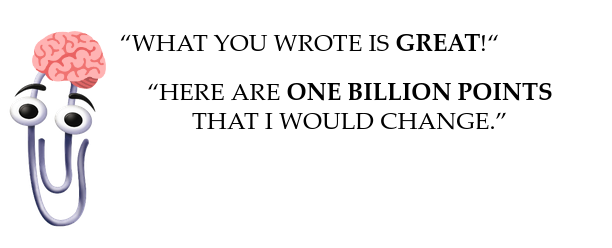
Let’s say I actually dig through this list, and fix everything as recommended. The funny part comes when I open a new dialogue session, and ask again for feedback. It’s back to step one: It will again find many new complaints and nitpicks, sometimes regarding its own previous recommendations.
Some of those highlighted issues and recommendations are useful to me. For example, they can help speed up the polishing of fluency or grammar, and make my English slightly more idiomatic. Sometimes it also finds more global coherence issues, e.g., of terminology and the likes.
But the thing is, many of the AI’s points are also not useful. So the tricky part is separating the useful from the non-useful in those feedback avalanches. The unhelpful points include those that remove my natural voice and those that distort the meaning of what I want to express, for example, due to the AI making implicit (but wrong) assumptions and extrapolations regarding what I would like to express.
So there’s this balance trick: I see that AI can make my writing better and faster in some ways. But too much of its “help” is confusing. It also risks making my manuscript* bland, too streamlined, and potentially even wrong. (There’s some irony in wording here that shouldn’t go unnoticed: *Manus stems from hand in Latin, so many manuscripts that we’re now reading aren’t actually manuscripts anymore.)
Tips
To conclude this post, here are five points that I believe to be helpful when using AI in a writing process:
-
Always write the first draft without any AI help. This helps me reflect and refine my own thoughts (…and prevents brain shrinkage.) Having finished the draft, carefully dosed usage of AI can come in handy for some refinement and speeding certain things up.
-
If the AI complains about something more conceptual or structural that you’ve written, try asking it: What would lead you to reconsider your view on this? Why would that what I had originally written be considered better? Chances are, the AI will flip its opinion and tell you about your writing being preferable in this context. Sometimes, reflecting those pro- and cons and revising the paper accordingly may lead to a material improvement, e.g., by pre-empting potential misunderstandings. And at other times you will simply come to the conclusion: Hey, maybe what I’ve written isn’t so bad, let’s stick with it!
-
If that what the AI spits out is starting to become more than 90% nitpicks, it’s a good sign that my text does not profit from more AI feedback, and my natural voice and unique thoughts are still preserved.
-
Never just blindly copy and paste parts of suggested AI rewrites. Chances are this will decrease the quality of what was written, and mess with the thoughts that one would like to convey.
-
Feedback from an attentive human reader remains the most useful. Try get human feedback when possible.
Disclosure
I did not use AI in any way for writing this post. It is 100% manu scriptum. As we say in German: “Whoever finds mistakes in above writing may keep them.”